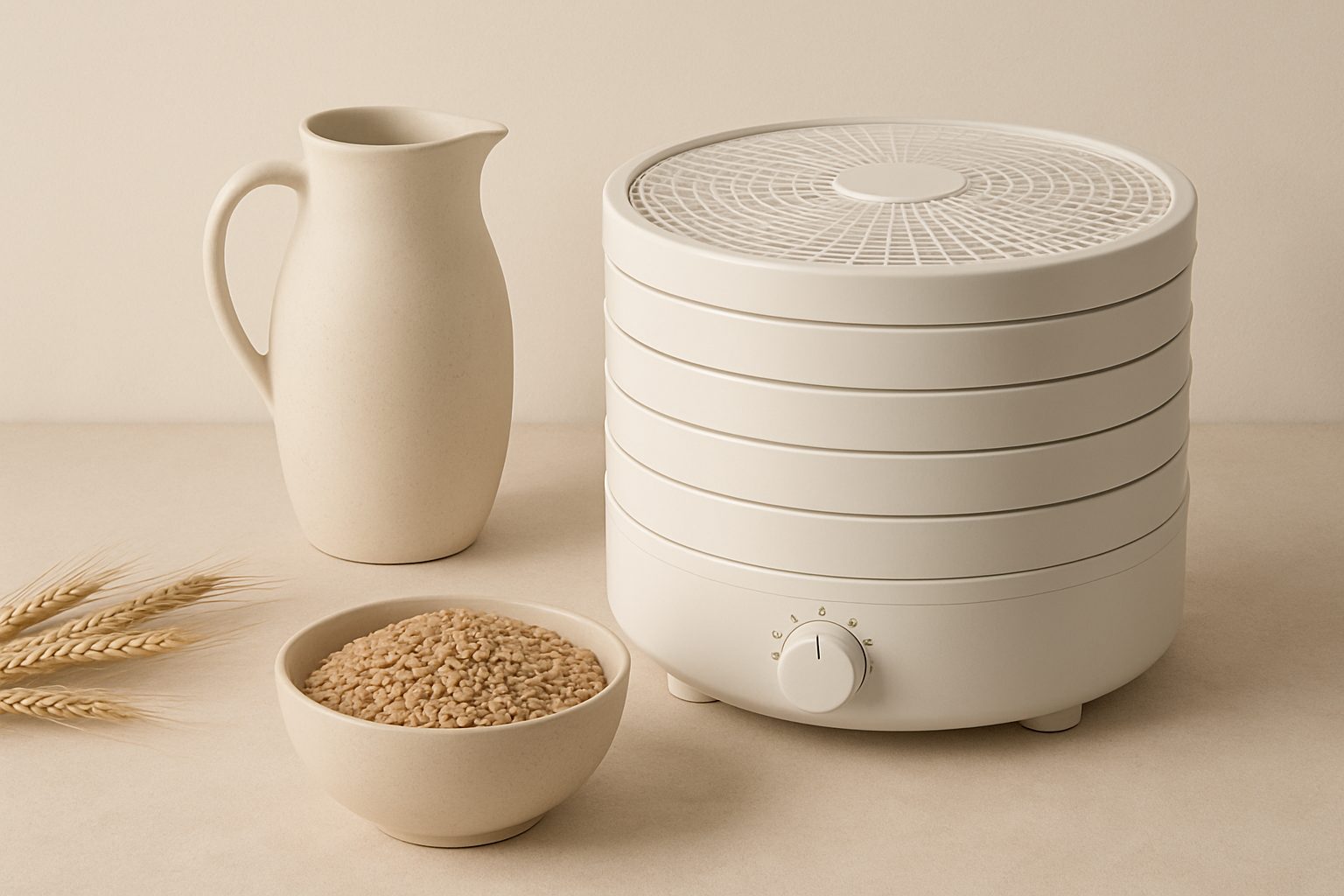
Home Grain Dryer vs Grain Moisture Meter: Do You Need Both?
If you grow your own grain—whether it's barley, wheat, oats, or something more specialist—you'll eventually face the question: do you need a grain dryer, a moisture meter, or both? The straightforward answer is that they're complementary tools, not alternatives. A grain dryer does the work; a moisture meter tells you when the work is finished. Each solves a different problem.
What a Grain Dryer Actually Does
A grain dryer removes water from harvested grain quickly and controlled. When you harvest, grain typically sits at 18–22% moisture content. That's far too wet for safe storage. Without drying, you risk mould, insect infestations, and spoilage within weeks.
A home-scale grain dryer forces heated air through a bed of grain, evaporating that moisture down to 12–14% (the safe storage threshold for most grains). The process takes hours, not months of sun-drying. For anyone with more than a small garden plot—or anyone in Britain's unpredictable climate—a dryer transforms what would otherwise be a gamble into something reliable.
Different dryer types have different advantages. Static dryers are simpler and cheaper but require you to turn the grain or shift it between batches. Continuous-flow dryers are faster and more efficient but cost significantly more. Most home growers choose a small static or batch dryer, which is perfectly adequate for 50–500 kg crops.
What a Moisture Meter Does
A moisture meter is simple: you take a sample of grain, insert it into the meter, and get a reading of moisture content as a percentage. A basic analogue meter costs £20–50. Digital meters are more precise and cost £50–150.
That's it. The meter doesn't dry anything. It just tells you what you've got.
But that "just" is crucial. Without one, you're guessing. You might think your grain is dry when it's still at 16%. Or you might over-dry it, wasting fuel and degrading the grain unnecessarily. Moisture directly determines storage life, milling quality, and whether your grain will actually keep.
Why You Need Both
Here's where the relationship becomes clear: a dryer is the tool; a meter is the reference.
Running a grain dryer without checking moisture content is like cooking without a thermometer. You might get it right, but you're relying on luck and experience. With a meter, you're using data.
Practically, this works like this:
- Pre-drying, you measure your fresh grain to establish a baseline. Is it 18% or 22%? How wet are you starting with?
- During drying, you measure periodically—every couple of hours in a static dryer—to watch the curve. You'll see it drops quickly at first, then more slowly as you approach your target.
- At target, when you hit 12–14%, you know it's time to stop. Without the meter, you'd keep running the dryer, wasting fuel and potentially over-drying.
- Before storage, a final check ensures it's genuinely dry enough for the intended use. Brewers and maltsters, for instance, often require different moisture levels than someone storing for next year's seed.
If you're drying for milling or malting, precision matters. A moisture meter pays for itself in fuel savings alone over a season or two.
Cost Considerations
This is where the "do you need both" question gets practical.
A decent small grain dryer costs £500–2,000, depending on type and capacity. A moisture meter costs £30–150.
If you're already investing in a dryer, skipping the meter to save £50–100 is false economy. The meter is perhaps 5–10% of your total investment, but it directly affects how efficiently you use the dryer.
That said, if you're only drying small quantities—say, a few kilogrammes for experimental malting or seed saving—a dryer might be overkill anyway. A moisture meter alone won't help you dry anything, but it will at least tell you whether what you've sun-dried or oven-dried has reached the threshold. In that scenario, a meter is genuinely useful without a dryer.
But if you're drying seriously—growing grain for storage, sale, or consistent milling—both are part of the setup cost.
Practical Decision Framework
Buy a dryer if:
- You're harvesting more than 20–30 kg of wet grain regularly
- Your climate makes sun-drying unreliable
- You want consistent results and can justify the capital cost
- You're drying for end-use (milling, brewing, malting) rather than seed-saving
Buy a meter if:
- You own a dryer (essential)
- You're sun-drying or oven-drying anything and want to know when it's actually done
- You sell grain or malt and need to guarantee moisture specs
- You're experimenting and want to learn what different grains need
Buy both if:
- You're serious about home grain production and can justify the combined cost
- You want to move beyond guesswork
- You're drying for any end-use beyond casual storage
The pairing works because each removes a different source of uncertainty. The dryer removes the time and climate uncertainty from drying. The meter removes the guesswork about when you're finished.
The Bottom Line
You don't need both—a farmer with decades of experience might dry by touch and eyeballing. But if you're starting out or scaling up beyond a small experiment, a moisture meter alongside your dryer is the practical choice. It's not fancy. It's just the information you need to use your dryer properly and know when to stop.
More options
- Electric Grain / Seed Dryer (Tabletop) (Amazon UK)
- Digital Grain Moisture Meter (Amazon UK)
- Airtight Food-Grade Grain Storage Buckets & Bins (Amazon UK)
- Inline Centrifugal Fan for Grain Drying (Amazon UK)
- Digital Thermostat Temperature Controller (Amazon UK)