Grain Dryer for Spelt and Heritage Grains UK: Gentle Drying Without Damage
Heritage grain varieties—spelt, emmer, einkorn, heritage wheats, and ancient barleys—have made a genuine return to UK farms and smallholdings. These crops demand different handling than modern commercial varieties, especially when it comes to drying. Standard grain dryers designed for high-volume wheat production often run too hot and too fast, damaging the delicate structure of heritage grains and destroying the very qualities—germination potential, nutritional density, distinctive flavour—that make them valuable. If you're growing spelt or heritage cereals, you need a dryer that respects the grain.
Why Standard Drying Fails Heritage Grains
Most commercial grain dryers operate at temperatures between 60°C and 80°C. For large-scale wheat, this works fine. But heritage grains are nutritionally denser, with more fragile protein matrices and higher levels of heat-sensitive nutrients. Temperatures above 50°C begin to denature some amino acids and reduce enzymatic activity, matters that concern craft bakers, malsters, and growers selling for germination or premium milling.
Spelt especially suffers from aggressive drying. The grain hull remains intact throughout the plant's life (unlike bread wheat, which threshes free), making the grain more porous and susceptible to moisture loss damage. Rush drying causes case hardening—the outer layer dries faster than the interior, trapping moisture and creating cracks that lead to breakage during milling or storage.
Similarly, if you're growing heritage grain for seed or micro-grain sprouting, high heat kills the embryo. Germination viability—critical for malsters and sprouting operations—drops sharply above 45°C.
Core Specifications for Heritage Grain Drying
When evaluating a grain dryer for spelt or heritage varieties, three things matter most:
Temperature control. Look for a dryer offering low-temperature operation, ideally with fine adjustment between 30°C and 50°C. Some smaller-capacity models designed for seed or specialty crops include thermostat control precise enough to hold temperature within 2–3 degrees. This is worth paying for.
Airflow management. Gentle, consistent airflow at lower speeds removes moisture without shock to the grain structure. High-velocity drying (common in large commercial dryers) causes stress fractures. A dryer with variable fan speed, or one designed for lower-volume throughput, naturally handles airflow more evenly.
Capacity relative to harvest volume. A 500 kg per hour dryer running at half capacity (250 kg/h) operates more gently than the same model pushed to maximum. If you harvest 5 tonnes of spelt a year, a 1-tonne-per-hour dryer is actually better than a 5-tonne unit. Slower throughput means finer control and less aggressive drying conditions.
Dryer Types That Work Well
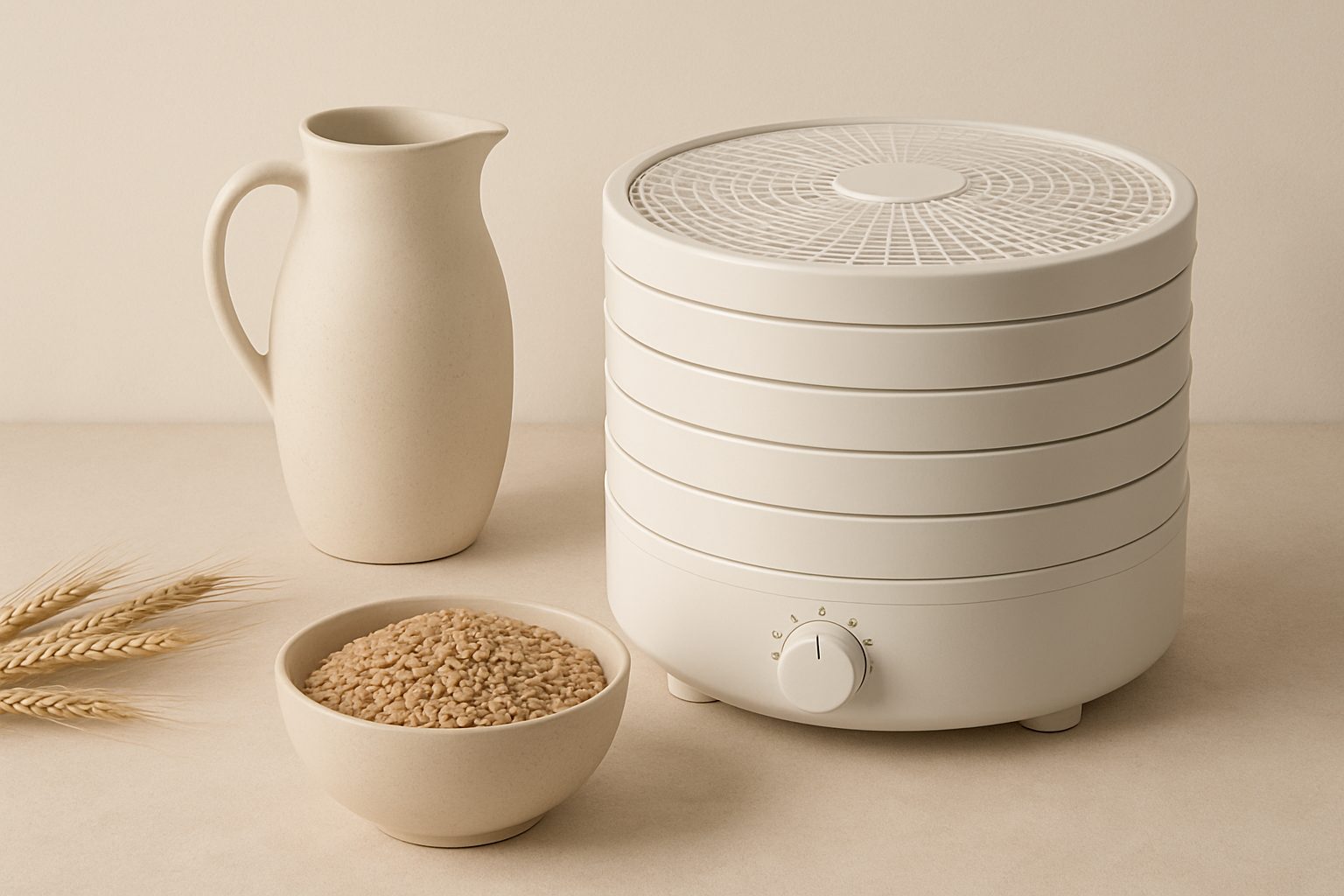
Flat-bed or tray dryers are excellent for heritage grains. These hold grain in shallow layers with warm air blown horizontally through the mass. Temperature stays low, drying is even, and you can interrupt and inspect the grain. They're slower than continuous-flow models but give you control. Expect to spend 8–12 hours drying spelt from 18% to 12% moisture. Smaller models (200–500 kg capacity per batch) are readily available from UK agricultural suppliers.
Continuous-flow dryers with low-temperature settings work if they're equipped with proper controls. The key is finding a model small or new enough to have adjustable temperature and speed. Some modern continuous dryers marketed for seed drying (rather than grain commodity use) offer this. Verify specifications—don't assume.
Column or bin dryers (where grain sits in a bin and warm air is drawn up from below) offer gentleness, but they're slow. They suit small operations and secondary drying, but wouldn't handle a large harvest alone.
Avoid high-speed continuous-flow dryers designed for bulk wheat grain. Even if adjustable, they're engineered for speed, not precision.
Practical Drying Approach
Most heritage grain growers in the UK use a two-stage method: one cycle at low temperature (40–45°C) to bring grain down to roughly 14–15% moisture, then a brief second cycle at slightly higher temperature (48–50°C) to reach final storage moisture (11–12%). This balances drying speed with grain protection.
Before loading, check moisture content with a grain moisture meter (cheap, essential). Moisture content varies by weather, harvest date, and variety; don't guess. Spelt typically comes in at 18–22% after combining.
Storage is the Silent Partner
Gentle drying is only half the equation. Once dry, heritage grains remain fragile. They need storage in cool, dry, vermin-proof conditions. Temperature fluctuation in an uninsulated shed causes condensation and mould. Humidity above 65% invites insects; below 10% makes grain brittle during milling. Sealed containers with silica gel desiccant, stored in a cool room, are standard practice among small-scale heritage grain producers.
Some growers invest in a small dehumidifier and sealed storage room as seriously as the dryer itself. The grain's value—whether for artisan milling, malting, or seed—depends on post-drying care as much as the drying process.
The Reality
Heritage grain drying isn't complicated, but it does require a different mindset than commodity grain farming. You're not trying to move tonnes per hour; you're trying to preserve the grain's integrity. A modest, controllable dryer paired with proper storage beats an oversized, aggressive one every time. For most UK smallholders and specialist growers, a tray dryer or a small continuous unit with genuine temperature and airflow control is the practical sweet spot: manageable cost, reliable results, and grain quality you can trust.
More options
- Electric Grain / Seed Dryer (Tabletop) (Amazon UK)
- Digital Grain Moisture Meter (Amazon UK)
- Airtight Food-Grade Grain Storage Buckets & Bins (Amazon UK)
- Inline Centrifugal Fan for Grain Drying (Amazon UK)
- Digital Thermostat Temperature Controller (Amazon UK)