Cheapest Grain Dryers UK Under £300: 6 Budget Picks Reviewed
Grain drying at home or on a small farm doesn't need to drain your budget. If you're working with modest volumes—small-scale brewing, permaculture plots, or testing crops before investing in larger equipment—several sub-£300 options deliver genuine results. The trade-off is usually time and capacity rather than outright failure, but it's worth understanding what you're actually getting.
Why Budget Grain Dryers Are Compromised (But Usable)
Commercial grain dryers cost thousands because they handle volume, maintain precise moisture control, and move air aggressively. A £150 option won't do that. What it can do is remove moisture slowly but steadily from small batches, provided you're patient and realistic about timescales. Most budget setups take 5–14 days for 5–15 kg of grain, versus 24–48 hours for commercial equipment. If you can wait, you can save substantially.
The real risk isn't wasted money—it's wasted grain. Damp grain rots; slow drying only works if your setup maintains airflow and prevents moisture from settling into the centre of your pile.
What to Look For in a Budget Dryer
- Airflow design: Perforated or slatted base that lets air circulate underneath (not around) the grain.
- Temperature control or low-heat operation: Grain over 43°C risks damage; budget models often lack thermostats, so passive or fan-only designs are safer.
- Containment: Sealed or semi-sealed chambers that force air through the grain rather than around it.
- Real capacity: "5 kg" usually means 5 kg per batch, not 5 kg final product; expect 10–20% moisture loss.
Six Budget Options Under £300
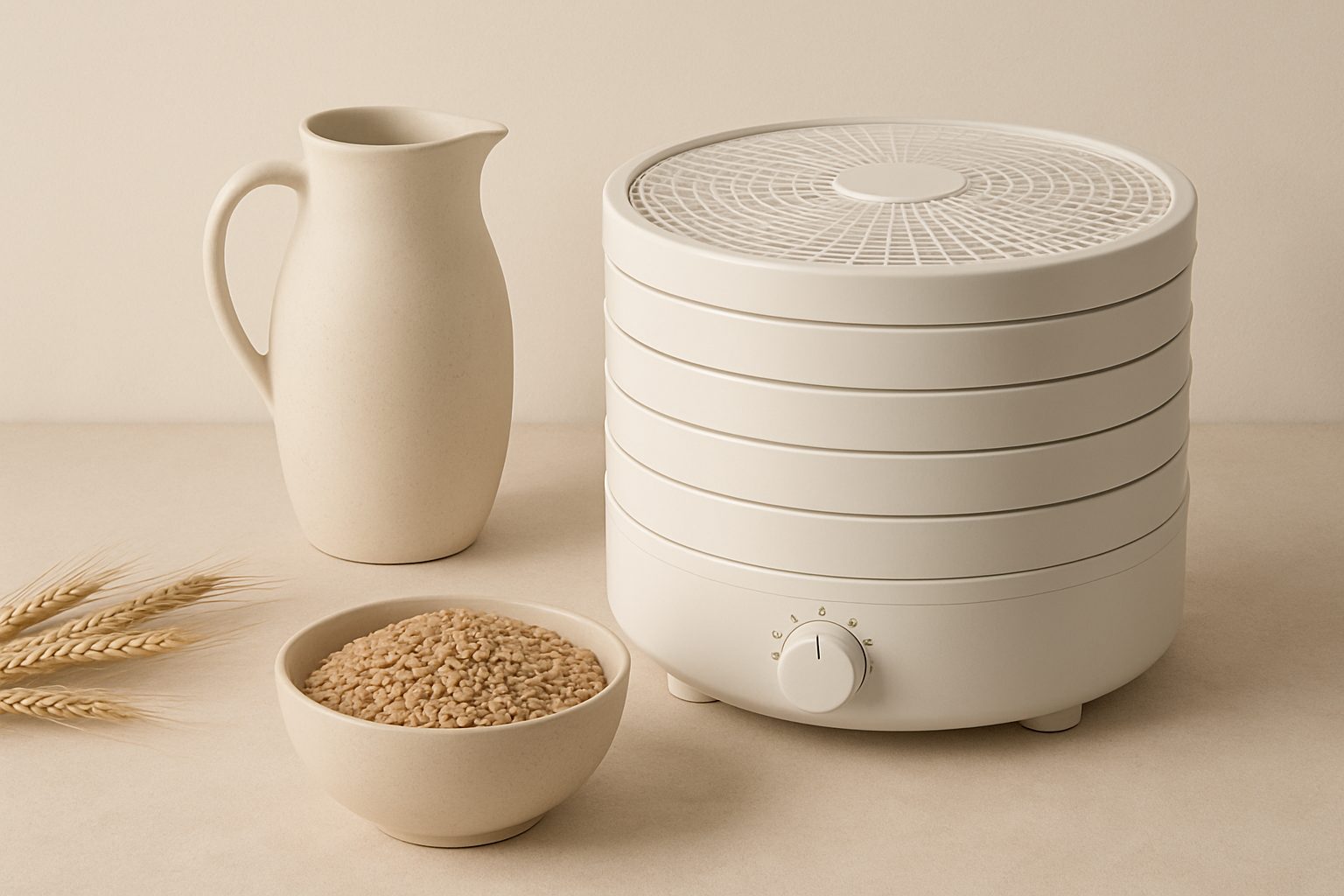
1. Repurposed Food Dehydrator (Excalibur or Budget Clone)
Cost: £80–180
A four-shelf food dehydrator is genuinely viable for small grain batches. Spread grain 2–3 cm deep on mesh or perforated trays, set to 35–40°C, and leave it running for 7–10 days. The advantage is precise temperature control and proven airflow design. The catch: you'll process 2–3 kg per batch, and your dehydrator won't be available for jerky.
Look for models with multiple trays and horizontal airflow (not vertical). Excalibur clones from Costco or Amazon (Ninja, Tefal) are widely available and reliable. Avoid single-tray models.
Real assessment: Slow, small-batch, safe. Best if you have another dehydrator or don't mind tying it up for weeks.
2. DIY Fan-Assisted Box (Self-Build, £60–150)
Cost: £60–150
A wooden or plywood box (60×40×40 cm) with a 12V or 230V computer fan or bathroom extractor mounted in one side, ducting into the base. Drill or cut a grid of 5 mm holes in the bottom to create an air plenum. Add a removable mesh tray rack 5 cm above the base, load grain to 5–8 cm depth, and run the fan continuously.
You'll need basic tools and access to a fan (computer fans from eBay, ~£15–30; bathroom fans, ~£30–50). The fan does the heavy lifting; grain dries in 5–7 days at room temperature or 2–3 days with gentle heat (low-power electric heater, ~£20–40, placed outside the box to warm incoming air).
Real assessment: Cheapest functional option if you're handy. Works, but you're responsible for airflow design and monitoring.
3. Wooden Smoking Box Modified as Dryer (£100–180)
Some suppliers sell basic wooden smoking boxes (charcoal-fired barbecue companions) that can be repurposed. Add an internal mesh rack or slatted shelf 10 cm above the base, and instead of charcoal, use a low-wattage thermostat-controlled heating element (£25–40) to maintain 35–40°C. Block the main vent partially and fit a simple exhaust ducting at the top to draw air through.
Not purpose-built, so design matters, but the structure is sound and the cost is reasonable.
Real assessment: Intermediate DIY; requires some modification but solid if executed properly.
4. Tabletop Dehumidifier + Sealed Container (£120–250)
Cost: £120–250
A small home dehumidifier (£80–120 on Amazon; ignore the "air purifier" marketing, just look for "dehumidifier") placed beside a sealed plastic storage box or wooden cabinet containing grain on mesh trays. The dehumidifier pulls moisture from the air inside the box; circulation is passive. Grain dries slowly—10–14 days for deeper batches—but reliably.
This is the laziest option: turn it on, come back in two weeks.
Real assessment: Slow but foolproof. Best if you have floor space and patience. Running cost is higher (dehumidifiers use more power than fans).
5. Basic Portable Cabinet Dryer (Commercial, Budget Brand, £150–280)
Cost: £150–280
Suppliers like GrainSafe or similar budget-focused brands offer simple cabinet dryers aimed at smallholders. These are usually a metal or plastic box with an internal fan, mesh trays, and either a thermostat or adjustable heating element. Capacity is typically 5–10 kg per batch. They're not robust—hinges and seals are flimsy—but they work.
Check reviews for the specific model: many budget units have poor airflow distribution and risk uneven drying. A common complaint is that edges dry much faster than the centre.
Real assessment: Purpose-built, so less DIY risk, but quality is variable. Read reviews before buying a specific brand.
6. DIY Gravity Dryer with Forced Air (£40–120)
Cost: £40–120
The simplest option: stack two or three large plastic storage boxes, drill a grid of 5 mm holes in the bottom of the lowest box to create an air plenum, and place a small 12V computer fan in the side (ducting from outside). Rest mesh racks inside, load grain to 5 cm depth per tray. Airflow rises through the grain and escapes through a vent in the top box.
This is fragile (plastic warps with heat), but at £40–60 in parts, you can afford to rebuild it next year. Drying time is 5–7 days at room temperature.
Real assessment: Ultra-cheap, nearly foolproof if airflow is correct, disposable lifespan.
The Honest Trade-Off
None of these options rival a £3,000 commercial dryer. They're slower, hold less, and demand more babysitting. But for 5–15 kg batches on a budget, they work. Success depends on three things: steady airflow (not stagnant air), stable temperature (35–40°C is ideal), and patience.
Grain that reaches 12–14% moisture after two weeks in a budget dryer will store perfectly. Grain left half-dry will rot. The method doesn't matter; the result does.
If you're processing more than 20 kg every few weeks, you'll outgrow these quickly and regret the time spent. If you're occasional or small-scale, one of these solutions will pay for itself in avoided commercial drying fees.
More options
- Electric Grain / Seed Dryer (Tabletop) (Amazon UK)
- Digital Grain Moisture Meter (Amazon UK)
- Airtight Food-Grade Grain Storage Buckets & Bins (Amazon UK)
- Inline Centrifugal Fan for Grain Drying (Amazon UK)
- Digital Thermostat Temperature Controller (Amazon UK)