Best Home Grain Dryers UK 2026: Top 7 Models Reviewed
Getting grain moisture levels right is critical if you're growing your own cereals, legumes, or seeds. A home grain dryer cuts drying time from weeks to days and reduces spoilage from the UK's humid climate. Whether you're a smallholder, hobby farmer, or organic producer, the right dryer transforms your harvest into storable grain — but choosing between electric cabinets, portable units, and tabletop models depends entirely on your scale and budget.
Why Home Grain Dryers Matter
Drying grain to 12–14% moisture content stops mould and pest damage, extends storage life to years rather than months, and lets you sell or mill with confidence. Sun-drying in Britain is unreliable: you're fighting cloud cover, temperature swings, and overnight dew. A dedicated dryer removes that gamble. Cost-wise, a modest £800–£3,000 outlay pays for itself after 3–4 harvests if you're processing 500+ kilograms annually.
The trade-off is electricity. Most electric dryers consume 3–5 kW per cycle. A 100 kg batch might cost £2–£5 in energy, depending on your tariff and drying temperature.
Electric Cabinet Dryers (500–1,500 kg/year capacity)
These are the workhorse choice for serious smallholders. A typical unit is a tall cabinet with an internal circulation system: grain sits in a drying chamber, warm air moves through it, and moisture vents out. Drying times are 18–36 hours depending on starting moisture and target level.
Pros: Consistent results, precise temperature control (usually 35–50°C), capacity to handle full harvests, minimal hands-on time once loaded.
Cons: Higher electricity use, takes up floorspace (roughly 60cm × 60cm × 150cm for a mid-range model), noise from the fan (typically 65–75 dB), initial cost £1,500–£4,000+.
Best for: Producers processing 800+ kg per year, anyone selling grain commercially, operations that can't risk spoilage.
Portable/Compact Electric Dryers (100–300 kg/year capacity)
Smaller electric units designed for hobby farmers and market gardeners. These often look like large dehumidifiers or compact boxes, running on standard 13A domestic plugs. Grain dries in a single layer or shallow tray; batches might be 20–50 kg.
Pros: Low capital cost (£400–£1,200), fit a garage or shed corner, easy to move, low noise (often 50–60 dB), use less electricity per batch.
Cons: Slower throughput, require more batches for large harvests, less precise temperature control, longer drying times (24–48 hours for shallow trays).
Best for: Home gardeners, small CSA operations, anyone testing the waters before investing in larger equipment.
Tabletop/Desktop Dryers (under 100 kg/year)
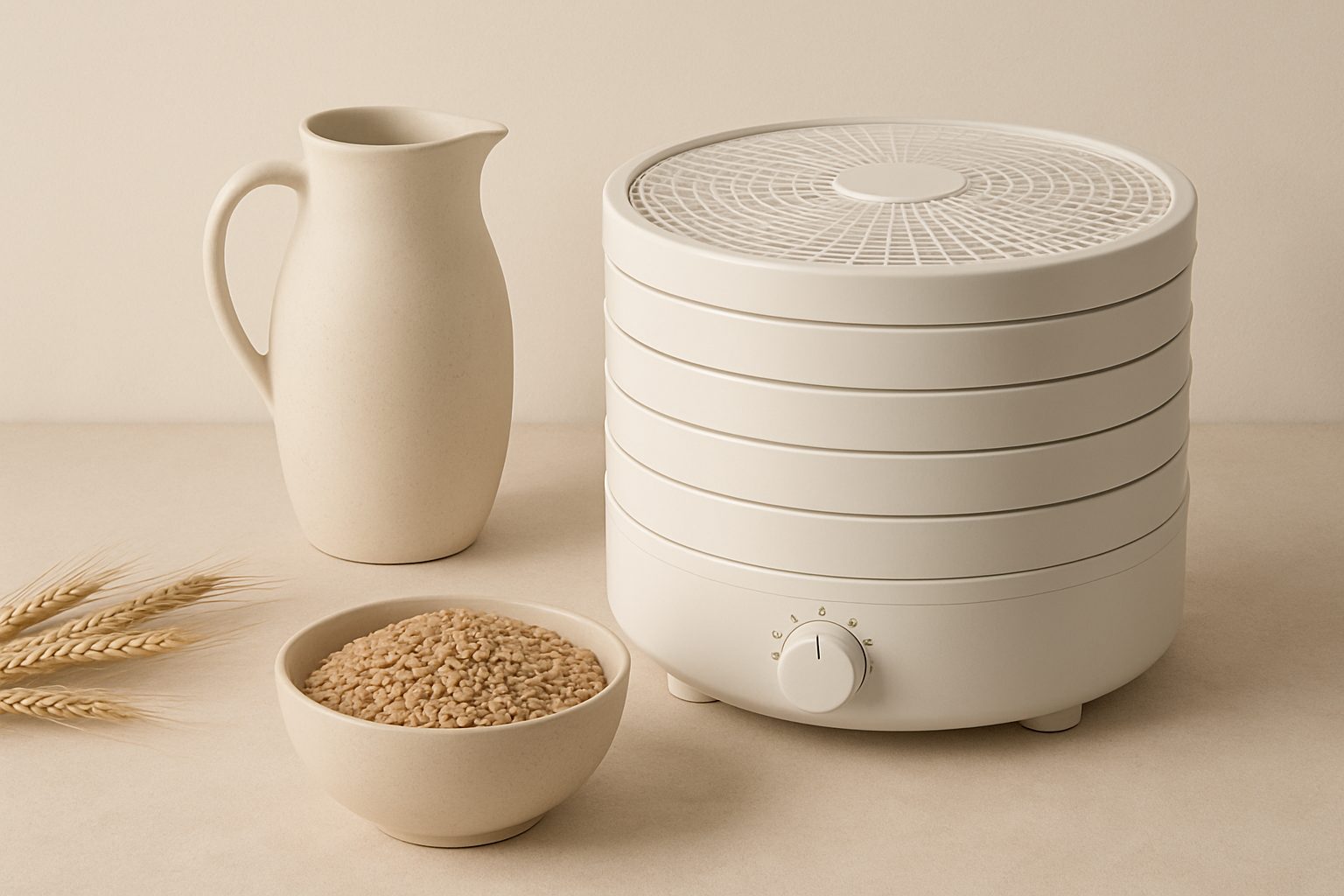
Bench-mounted units resembling food dehydrators but sized for grain. Usually mesh trays stacking inside an insulated box, with a small heating element and fan.
Pros: Minimal space (50cm × 50cm footprint), lowest entry cost (£200–£600), almost silent, suit single-digit kilogram batches.
Cons: Tiny capacity, glacial throughput, tedious for serious harvests, less reliable temperature management, some models designed for herbs/spices rather than grain.
Best for: Experimental growers, people drying heritage seeds, anyone with under 50 kg annual throughput.
Key Specifications to Compare
Drying Temperature Range: Look for 35–50°C; anything above 60°C risks damaging grain. Legumes are more heat-sensitive than cereals.
Moisture Sensor: Units with built-in sensors auto-shutoff at target moisture (typically 12–14%), saving guesswork and energy.
Air Flow: Horizontal air circulation (side-to-side) dries more evenly than vertical. Check specs or reviews.
Energy Consumption: Reputable makers publish kW/hour. Budget £2–£6 per 100 kg load depending on starting moisture.
Noise Level: Cabinet dryers are louder; if you're near neighbours, ask for decibel ratings. Portables are generally quieter.
Warranty and Parts: Check if heating elements and fans are replaceable and stocked in the UK. Some imported units need parts shipped, adding weeks and cost.
Drying Your First Batch
Start by testing grain moisture with an inexpensive grain meter (£40–£80). This tells you how much water you're actually removing — critical for settings and troubleshooting.
Load evenly; don't overstuff. Air needs to circulate. Run the dryer on low-to-medium heat first; you can always dry hotter if needed. Check progress every 6–8 hours and stir the grain if the dryer lacks internal agitation.
Once dry, cool grain fully before sealing — warm grain in an airtight container risks condensation. Store in a cool, dry place; 12–14% moisture keeps for 1–2 years if protected from moisture and pests.
Climate and Location
The UK's maritime climate—high humidity, temperature fluctuations, frequent cloud cover—makes artificial drying genuinely valuable. Southeast England, where summer dew is heavier, benefits most. Even in the drier east, grain dried in July can reabsorb moisture indoors if storage isn't sealed.
The Verdict
Start with a portable unit if you're new to grain growing: low risk, real results, and you'll learn what you actually need. Step up to a cabinet dryer once you're harvesting 500+ kg and need to process faster. Tabletop units are mostly for seed-savers and experimental work.
Choose a dryer with UK-stocked parts and a maker who supports it beyond the sale. The cheapest unit is expensive if you can't get a replacement heating element in winter.
More options
- Electric Grain / Seed Dryer (Tabletop) (Amazon UK)
- Digital Grain Moisture Meter (Amazon UK)
- Airtight Food-Grade Grain Storage Buckets & Bins (Amazon UK)
- Inline Centrifugal Fan for Grain Drying (Amazon UK)
- Digital Thermostat Temperature Controller (Amazon UK)